
When wine tells us about marketing...
An interactive training with Mota Winery to discuss marketing strategies.


Your customers will pay you because you solve a problem for them.
You don’t sell a product: you fill a need. So before defining your communication strategy, ask yourself: what problem does what you are offering solve?
E.g.: a restaurant gives you more than just food. It is a place to socialize with your friends and family first and foremost. Then a place that allows you not to have to cook, or that everyone at the table can eat what he/she wants…
Focus your communication on the problem you are solving.
Your customers won’t buy from you because they understand what you do. They will buy from you if they feel that YOU UNDERSTAND THEM. What problem you have, and what solution you thought of to solve it.
Identify your competitors
Who else solves the same problem as you? By asking yourself this question you can identify two types of competitors:
- your direct competitors: are those who solve the same problem as you, and with the same type of product or service as you. E.g.: if you have a restaurant, the other restaurants in the area where yours is located are your direct competitors.
- your indirect competitors: are those who solve the same problem as you, but do not offer the same product or service as you. These are a bit more difficult to identify 🙂 . E.g.: if you have a restaurant, the Mercadona that opened in your street and offers a take-away service is an indirect competitor.
What to do with this info?
This info will allow you to get several key data in your communication:
- What is your differential value with respect to your direct competitors: what do you do better or differently? Are you faster/friendlier/original/cheaper, etc.? A differential value will be even more so if it allows you to solve your audience’s problem even better.
- What arguments could you give to your public not to choose an indirect competitor and choose you instead? Ex: why have a picnic and be badly seated on the beach when my restaurant overlooking the sea is so cool and comfortable?
What happens to a person who seeks to please everyone? In the end, no one likes him. Or arouses indifference. This is JUST what you want to avoid with your brand.
So, point 1:
Your product is not for everyone... And that's fine!
Your buyer persona is the ideal customer for your business. The one for whom your product is really designed. It is key that you have it perfectly identified.
Note: you may have SEVERAL BUYER PERSONS if you have several types of product.
Key questions to ask yourself to identify your buyer persona
Where do you live?
How old are you?
Does it matter whether you are a man or a woman?
What do you like? What is your personality like?
What problem do you solve for him?
Buyer, prescriber, consumer
These are the three pillars of the buying process. It is key that you know whether your communication is focused on the buyer, the prescriber or the consumer.
- The buyer: is the one who pays for the product or service.
- The prescriber: the one who recommends to buy it.
- The consumer: the one who consumes the product.
E.g.: a child who asks his parents for cookies at the supermarket is the prescriber and the consumer. The parents are the buyers.
Sometimes, the buyer, the prescriber and the consumer are 3 different people. Sometimes, the same person is more than one of these pillars, or all of them (e.g., you convincing yourself that you need to join a gym).
Time to define your communication strategy: create stories around your brand.
Look at what you see right now at Bodega Mota. Do you see that they tell you much more than the fact that they sell wine? What stories to tell can you identify in this winery?
We all love to be told stories.
Connect with the problems your product solves by focusing your story from:
- your consumer’s perspective: what would he/she like to hear knowing the problem he/she has?
- the most human perspective of your brand: involve your team, tell why you created this project, funny/exciting/curious anecdotes.
Stories make your brand REMEMBERED.
Brand positioning and pricing strategy
Having a clear idea of who your competitors are, the next steps you need to take are:
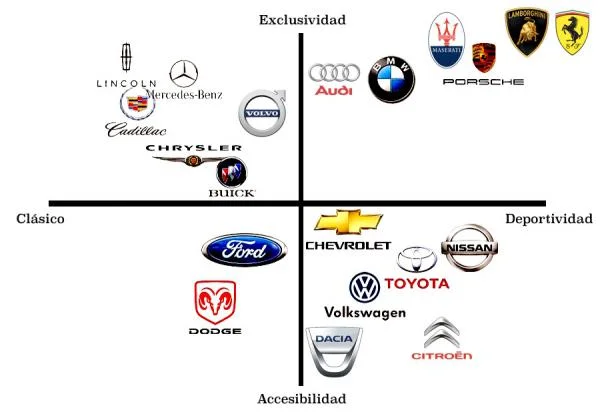
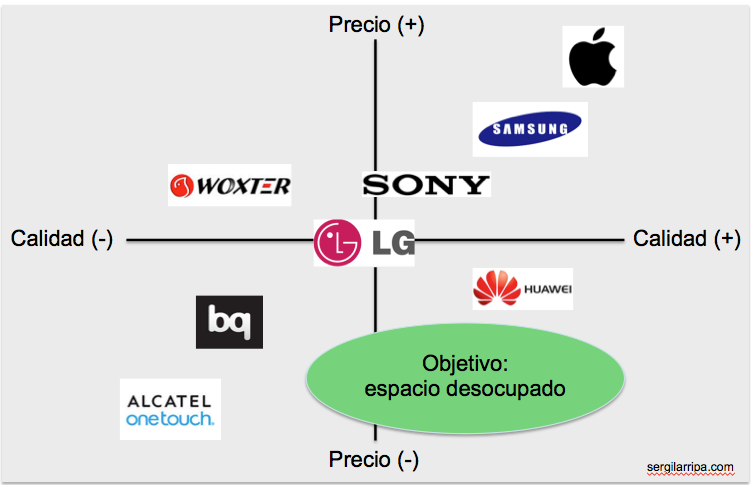
- Define your brand positioning: high-end, low-end, mid-range. What positioning are your competitors in? Define a brand positioning matrix according to your key variables.
- define your prices: they must be consistent with your brand positioning.
Your brand positioning should be reflected in all aspects of your business.
The product itself, of course. But not only, but:
your production costs:
- the packaging
- the service
- complaint management
- communication
E.g.: Ryanair vs. Emirates.
Key questions to define your pricing and positioning
How much does it cost you to sell it? Advertising costs, shipping, packaging, customer service
Where are your competitors positioned in a quality/price matrix, or a matrix with
key criteria for your sector?
Examples of brand positioning matrices
Values: the soul of your brand
People work with people. You don’t choose brands, you don’t choose logos. You choose projects that connect with your way of being, with your beliefs, with your way of living. In short, with your VALUES.
- What ideas and human values are connected to your brand, to the story of your project?
- In short: what HUMANIZES your brand?
It’s not about telling perfect stories but AUTHENTIC ones. Imperfection can, in fact, make us connect even more. While it is key to take care of the image of your brand, a video in which you get excited talking about your project will connect a million times more than any product photo that looks like it came out of a catalog.
Neuromarketing basics: engage your viewers
You continuously react to external stimuli: what you see, smell, taste, hear or feel conditions your decision making or your unconscious reactions. This is the basis of neuromarketing.
Understanding and applying this key to your business is fundamental: create an environment that leaves an impression on your public. From your own perfume, to your own colors, to a sensation when your customers enter your store… If you are able to connect with your audience beyond what you SELL but rather what they REMEMBER about your brand… You will have reached the purpose of a marketing strategy: to make your customers feel in a very special way when they connect and consume your brand. And if you want an example… look up for a moment from your cell phone and pass it by this beautiful winery we are in today. 😉
Conclusion: seduce with your brand story
If you liked it, leave us a review by clicking on the button below.
(And if not, take advantage that you have Gladys here and tell her… your feedback will always make us better. Thanks 🙂 )